Time Sensitivity

As Ramadan comes to a close and the remaining few days fly over our heads, many of us wonder at where it disappeared. We dust off our Qur’ans and gun our engines to catch salaah at the masjid–Taraweeh, Qiyam al-Layl, or just the daily five.

All of us acquire a certain sensitivity to time. Suddenly, every day, every hour counts. We think twice about spending two hours here or half an hour there on things we normally just do. (And university students experience this at midterm and exam time; workers experience this when deadlines loom.)
Eid Mubarak!

Just like we have different starting dates for Ramadan, we have different Eid dates.

And you know what? That’s ok. Why? Because it’s all based on legitimate difference of opinion. Not some beardy guy making stuff up because he feels like it.

So when ‘Eid rolls around, enjoy it, and don’t hate on other people for when they celebrate. That’s messed up.

By the way–when ‘Eid rolls around, remember this: you just fasted for 30 days straight, give or take a day. You prayed. You abstained from sins, from backbiting, from looking a second time. Don’t stop doing that! That is taqwa of Allah–the real stuff–that you built up in yourself, fast by fast, day by day, and deed by deed. Nurture it. Improve it. Maintain it, so it doesn’t degenerate.

The Purpose of Fasting

One of the verses of the Qur’an we hear all the time in the context of fasting is this one:

يَا أَيُّهَا الَّذِينَ آمَنُواْ كُتِبَ عَلَيْكُمُ الصِّيَامُ كَمَا كُتِبَ عَلَى الَّذِينَ مِن قَبْلِكُمْ لَعَلَّكُمْ تَتَّقُونَ

Translation: O you who believe! Allah prescribed fasting upon you, as it He prescribed for those before you, that you may attain taqwa (piety, God-consciousness). [Al-Baqarah, 2:183]

Those last two words summarize the entire purpose of fasting: to attain taqwa.

‘Umar and the Eloquent Woman

The Messenger of Allah (صلي الله عليه وسلم) said, in a long hadith: “A believer should speak good or keep silent!” We all know this hadith, right?

But how do we implement this hadith? What if someone does something wrong? What if they deprive us of our rights? Should we still keep silent, or give them 80 lashes with our tongues?

Check this out–this incident ocurred during the life of ‘Umar ibn Al-Khattab (رضي الله عنه), second Khalifa of Islam.

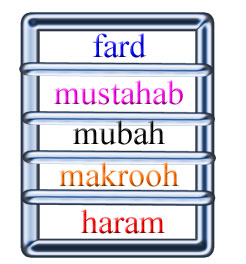
Five Categories of Everything

Those five categories of all actions–fard (also known as wajib), mustahab (sometimes called “sunnah”), mubah, makrooh, and haram–what do they really mean? While you can understand these from different angles, we explain these from an Usool-ul-Fiqh perspective. Here they are:


Ruling Meter

Fard/Wajib (obligatory) means any action that you earn a reward for performing, and earn a punishment from abstaining from. Examples include praying, fasting, etc.

Mustahab/Sunnah (recommended) means any action that you earn a reward for performing, and earn nothing from abstaining from. Examples include breaking your fast as soon as it’s Maghrib time, praying two rakaahs after Maghrib, using miswaak, etc.

Ramadan Burn-Out

Ramadan is the month of Qur’an. A month where many of us fast, pray Taraweeh, pray Qiyam al-Layl, and read the entire Qur’an–maybe more then once!

But subhanallah, in our love for Ramadan and our zeal for good deeds, we sometimes aim to accomplish more then our human capacity. We’re humans, we all have limits.

But people say “I’m going to read the WHOLE QUR’AN this time!” when they can’t–sometimes, even reading only one juz, maybe even the last juz, is an accomplishment for them, one within their ability. But they plough on, undettered, increasingly more tired and more tired and more burned out every day, until finally ‘Eid arrives and they say “Thank God Ramadaan is over!”

Five Sunnahs of Fasting

The Prophet (صلي الله عليه وسلم) taught us five favourable (mustahab or “sunnah”) actions for us to follow while fasting. These are:

  1. Hasten Iftaar: When Maghrib time arrives, hasten to break your fast–do not delay. It’s said that he, (صلي الله عليه وسلم), sent Bilal (رضي الله عنه) to stand on top of a high-up hill to see when the sun set, then broke his fast immediately.
  2. Eat Suhoor: A lot of cultures teach us to skip suhoor and start fasting when we sleep. (Though nobody skips the sunnah of hastening iftaar …) Aside from being (medically) bad for you, it extends the length of your fast by a good six or more hours.
Forget that. Eat suhoor–and close to Fajr time–and with this, with iftaar, protects your fast–dawn to sunset. The Prophet (صلي الله عليه وسلم) said: My nation will remain in goodness as long as they break the fast as soon as it is due. [Muslim]
  1. Pray Fajr: The Prophet (صلي الله عليه وسلم) never, ever missed Fajr intentionally, ever. Skipping salaah entails a major sin! Scholars differ on whether you are considered Muslim or not if you skip prayers intentionally, i.e. whether you will enter Hellfire forever–may Allah protect us all. So don’t do it! If you eat suhoor close to Fajr anyway, it becomes very easy to pray Fajr. If you have access to transportation, pray at the masjid and get the benefit of multiplied good deeds deposited in your account.
  2. Avoid Foul Language: The Prophet (صلي الله عليه وسلم) said: Whoever does not give up forged speech and evil actions, Allah is not in need of his leaving his food and drink (i.e. Allah will not accept his fasting.) [Bukhari 3/31/127, Muslim] So no swearing, lying, backbiting, insulting, etc. You wouldn’t want to struggle though all that hardship, to end up with an unaccepted fast, would you?
  3. Make Du’a at Iftaar: A lot of people miss out on this. We cram dates into our mouth when the adhaan sounds, then rush off to make wudoo or pray Maghrib.
The Prophet (صلي الله عليه وسلم) said: Three prayers are not rejected: the prayer of a father, the prayer of a fasting person, and the prayer of a traveler. [Al-Bayhaqi, Saheeh [according to Al-Albani][2]] [1]

So keep it simple: stick the date in your mouth and raise your hands to the sky. You get the best of both rewards!

And remember, the reward of following a sunnah (or musthabb–recommended act) is an accreditation of good deeds in your account. And we can all do with more good deeds.

Muhaddith Al-Albani

A Muhaddith is one who studies and memorizes ahadith, and internalizes the science of hadith–the science that allows us to dissect and analyze ahadith and sort the authentic from the un-authentic. (You can read more about ahadith and their statuses here.) This includes memorizing the biographies of people involved in the narration, including their strengths and weaknesses (in terms of memory and piety).

Shaykh Muhammad Nasir-ud-Deen al-Albani, one of the greatest scholars of recent times, also studied ahadith and became a muhaddith–one the likes of we have not seen in centuries. This is why many contemporaries–scholars, imams, teachers–often will quote a hadith as saheeh or da’eef and say “according to Shaykh Al-Albani”. May Allah forgive his sins and accept all the amazing work he completed during his lifetime, ameen!

Fire Exits in the Qur’an

Whenever Allah (سبحانه وتعالى) mentions the Fire, He (سبحانه وتعالى) always mentions a fire exit–usually immediately afterwards. There’s always a chance to escape. But once you die, there’s no fire exit.

For example, in Surah Baqarah, Allah (سبحانه وتعالى) says:

فَإِن لَّمْ تَفْعَلُواْ وَلَن تَفْعَلُواْ فَاتَّقُواْ النَّارَ الَّتِي وَقُودُهَا النَّاسُ وَالْحِجَارَةُ أُعِدَّتْ لِلْكَافِرِينَ
وَبَشِّرِ الَّذِين آمَنُواْ وَعَمِلُواْ الصَّالِحَاتِ أَنَّ لَهُمْ جَنَّاتٍ تَجْرِي مِن تَحْتِهَا الأَنْهَار

Translation: But if you cannot–and you can never do it–then fear the Fire whose fuel is men and the stones, prepared for the Unbelievers. And give glad tidings to those who believe and do good deeds, that for them are Gardens, beneath which rivers flow! [Surah Al-Baqarah, 2:24-25]

The Qur’an: It’s All For You!

When you read the Qur’an, cultivate the mentality that every single surah, verse, ayah, and letter was revealed for you, personally.

Verse addressed to Banu Israeel (Jews)? Maybe Ahlil Kitaab (people of the book)? Or maybe An-Naas (humankind)? Or even the obvious, to those who believed? Yes, it addresses them–but it also addresses you. Learn from their past–their triumphs and their defeats, their actions and their mistakes, their joys and their pains.