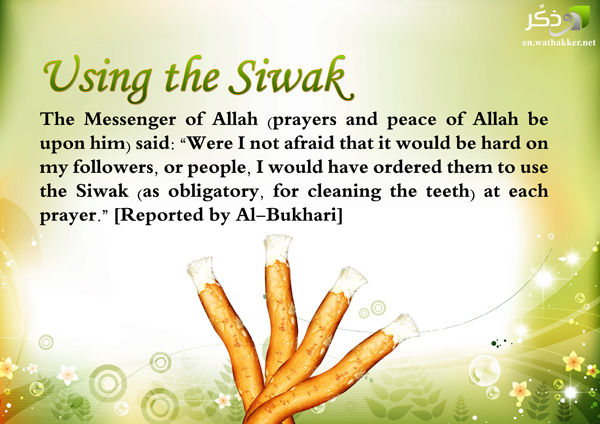
A Siwaak a Day

This is the continuation of the series, that focuses on implementing sunnah in our lives. I hope everyone had emaan rushed Ramadhan and you were able to apply the things we learned in this series.

Here is the sunnah items, we will be focusing on in this week:

Using Siwak:

Action Item:

Follow the Sunnah – Week 5

Here is the sunnah items, we will be focusing on in this week:

Making Dua:

  • Raise your hands
  • Glorify and praise Allah, in the beginning and at the end
  • Send salutations on Prophet (May Allah Peace and Blessing be on him) in the beginning and at the end
  • Cry while making dua

Adhaan:

Breakfast:

Follow the Sunnah – Week 4

Last week, we focus on the sunnah of making ablution and coming out of the washroom. Here is the sunnah for this week:

After the fard salahs:

  • After slautation, say Allahu Akbar in loud voice
  • Say “Astagfirullah” thrice in low voice
  • Recite “Ayat Kursi”
  • Read the morning and evening supplications after farjar and asar prayers (Another Link)
  • Recite other Adhkars and Supplications
  • Pray the two rakahs of ishraq after the fajar prayer (The Messenger of Allah [SAWS] said, “Whoever prays the dawn prayer (fajr) in a group and then sits and does dhikr until the sun rises, then prays two rakas, shall have the like of the reward of a hajj and an umra.”)

Tip of the Week:

Follow the Sunnah – Week 2

Last week, we started a new series. The goal of the series is to learn and implement the sunnah in our lives. We started with the sunnah of our beloved Prophet (May Allah’s peace and blessings be upon him) on waking up. I hope all of you have been practicing that sunnah. Here is the sunnah for this week:

Entering the Washroom:

After Entering the Washroom:

Follow the Sunnah – Week 1

Allah Subhannallah, tells us in the Quran:

لَّقَدْ كَانَ لَكُمْ فِي رَسُولِ اللَّـهِ أُسْوَةٌ

حَسَنَةٌ لِّمَن كَانَ يَرْجُو اللَّـهَ وَ

وَذَكَرَ اللَّـهَ كَثِيرًا

Translation:

There has certainly been for you in the Messenger of Allah an excellent pattern for anyone whose hope is in Allah and the Last Day and [who] remembers Allah often.[Surah Al-Ahzab, verses 21]

The oxford dictionary defines the word ‘role model‘ as “A person looked to by others as an example to be imitated.” Indeed, our beloved prophet, has left us with the best examples, to be emulated. Take any part of your life, be it be eating, drinking, walking, sleeping, and you will find the best example in the life of our Prophet. He remembered Allah all the time.

Ikhtilaf – I

In the previous post, we introduced the topic of Differences of Opinions. We listed the four ways of categorizing these differences. In this post, we will look at the first category: Differences due to interpretation of word meanings and grammatical constructions.

Within this category, we have several sub categories:

Shared literal meanings/Equivocality/Homonym (Ishtirak):

An example of this would be the word “qur” which means menses as well as the time of purity between menses. This word occurs in 2:228. The scholars thus arrived at two different rulings for the waiting period of divorce. According to those who considered  Qur’ to be the period of purity, the divorce becomes finalized as soon as her third menses have started, while according to those who viewed Qur’ as the actual menses, it is not finalized until her third menses have ended. You can read the details here.

Mcdonald, KFC, Moon Sighting…

Muslims, living in the Muslim Countries, generally tend to have limited exposure to Fiqh and its rulings. There is usually one dominant madhab and that’s all people know about. Rarely, if ever, people are exposed to other madahibs. However, the situation for many of us living in west, like Canada, is quite different.

Because of the diversity of muslims, from various countries, cultures and backgrounds, we are exposed to many madhabs. We find many different opinions on a given issue. We see people praying little differently in mosque. When Ramadhan comes, the whole moon sighting debate starts and not to mention the zabiha meat issues.

Tafseer Surah Nazi’at, Part 2

This is post #43 in our series on Tafseer of Juz ‘Amma (click the link to see all posts in this series).

Continuing into our foray of tafseer of Surah An-Nazi’aat, we reach the story of Musa (alayhi salaam). Allah (‘azza wa jal) says:

هَلْ أَتَاكَ حَدِيثُ مُوسَىٰ

Translation: Has there reached you the story of Moses? [Surah Naazi’aat, verse 15]

One of the interesting aspects of Qur’an you don’t get from the translation is discourse. (A discourse is a single discussion on a single topic.) In the Qur’an, Allah (‘azza wa jal) used rhyming to distinguish different discourses. This means that when the rhyming changes (look at the form of the last word), you can tell that the topic, too, is changing.