Gems

‘Umar and the Eloquent Woman

The Messenger of Allah (صلي الله عليه وسلم) said, in a long hadith: “A believer should speak good or keep silent!” We all know this hadith, right?

But how do we implement this hadith? What if someone does something wrong? What if they deprive us of our rights? Should we still keep silent, or give them 80 lashes with our tongues?

Check this out–this incident ocurred during the life of ‘Umar ibn Al-Khattab (رضي الله عنه), second Khalifa of Islam.
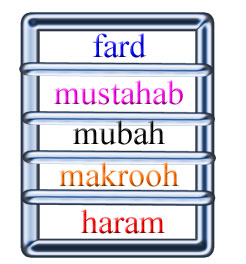
Five Categories of Everything

Those five categories of all actions–fard (also known as wajib), mustahab (sometimes called “sunnah”), mubah, makrooh, and haram–what do they really mean? While you can understand these from different angles, we explain these from an Usool-ul-Fiqh perspective. Here they are:


Ruling Meter

Fard/Wajib (obligatory) means any action that you earn a reward for performing, and earn a punishment from abstaining from. Examples include praying, fasting, etc.

Mustahab/Sunnah (recommended) means any action that you earn a reward for performing, and earn nothing from abstaining from. Examples include breaking your fast as soon as it’s Maghrib time, praying two rakaahs after Maghrib, using miswaak, etc.

Fire Exits in the Qur’an

Whenever Allah (سبحانه وتعالى) mentions the Fire, He (سبحانه وتعالى) always mentions a fire exit–usually immediately afterwards. There’s always a chance to escape. But once you die, there’s no fire exit.

For example, in Surah Baqarah, Allah (سبحانه وتعالى) says:

فَإِن لَّمْ تَفْعَلُواْ وَلَن تَفْعَلُواْ فَاتَّقُواْ النَّارَ الَّتِي وَقُودُهَا النَّاسُ وَالْحِجَارَةُ أُعِدَّتْ لِلْكَافِرِينَ
وَبَشِّرِ الَّذِين آمَنُواْ وَعَمِلُواْ الصَّالِحَاتِ أَنَّ لَهُمْ جَنَّاتٍ تَجْرِي مِن تَحْتِهَا الأَنْهَار

Translation: But if you cannot–and you can never do it–then fear the Fire whose fuel is men and the stones, prepared for the Unbelievers. And give glad tidings to those who believe and do good deeds, that for them are Gardens, beneath which rivers flow! [Surah Al-Baqarah, 2:24-25]

The Qur’an: It’s All For You!

When you read the Qur’an, cultivate the mentality that every single surah, verse, ayah, and letter was revealed for you, personally.

Verse addressed to Banu Israeel (Jews)? Maybe Ahlil Kitaab (people of the book)? Or maybe An-Naas (humankind)? Or even the obvious, to those who believed? Yes, it addresses them–but it also addresses you. Learn from their past–their triumphs and their defeats, their actions and their mistakes, their joys and their pains.

Ramadan: The Excuse-Killer

Ramadan kills all the excuses we make for ourselves throughout the year, and allows us to soar to new heights of eman!

If someone said to you, “let’s go to the masjid every day,” you’d say “we can’t do it!” but, in Ramdan, you do it! If someone said “let’s play Qiyam al-Layl all night,” you’d say “we can’t do it!” but, in Ramdan, you do it! Subhanallah, in Ramdan, wishes and hopes and dreams can become reality!

Increase Your Barakah

Now that you know what barakah is, you might ask, how can one increase the barakah in his or her life? Aside from visiting the places with barakah, and making use of times with barakah, what else can you do?

The answer is very simple. If you want Allah (سبحانه وتعالى) to bless you, then do anything for the sake of Allah, upon the sunnah (methodology) of the Prophet (صلي الله عليه وسلم).

Thus every act can become a candidate for more barakah. Even things like going to work and shopping for food–properly done, with the right intention, can become something blessed. You’ll be more productive at work. The food you buy feeds you for a longer time. And so on.

The Mu’min Tree

In Surah Ibrahim, Allah (سبحانه وتعالى) gives us the metaphor of the kalimah (la ilaha ilallah) as a beautiful tree. The verse is:

أَلَمْ تَرَ كَيْفَ ضَرَبَ اللّهُ مَثَلاً كَلِمَةً طَيِّبَةً كَشَجَرةٍ طَيِّبَةٍ أَصْلُهَا ثَابِتٌ وَفَرْعُهَا فِي السَّمَاء

Translation: Have you not seen how Allah has given the parable of a beautiful kalimah, like a beautiful tree, whose roots are firmly established, and whose branches tower in the sky? (Surah Ibrahim, verse 24)1

Pre-Emptive Parental Kindness

Kindness to parents is pre-emptive–you fulfill their needs and wants before they can ask, before they even know it themselves.

Kindness to parents is pre-emptive–it means you fulfill their needs before they ask. It’s not antagonistic, where they ask and ask and ask until you give in and do what they say. It’s not passive, where they have to tell you every little thing they need. It’s active, so take the initiative and do what needs to be done, in order to earn the pleasure of Allah.

Mushrikeen Believed in Allah

Belief in Allah

Check this out. The mushrikeen, now and in the time of the Prophet (صلي الله عليه وسلم), believed in Allah (سبحانه وتعالى). Remember, these are the people who rejected Islam, and who are among the worst of people.

In Surah Ankabut, Allah (سبحانه وتعالى) says:

وَلَئِن سَأَلْتَهُم مَّنْ خَلَقَ السَّمَاوَاتِ وَالْأَرْضَ وَسَخَّرَ الشَّمْسَ وَالْقَمَرَ لَيَقُولُنَّ اللَّهُ
[…]
وَلَئِن سَأَلْتَهُم مَّن نَّزَّلَ مِنَ السَّمَاء مَاء فَأَحْيَا بِهِ الْأَرْضَ مِن بَعْدِ مَوْتِهَا لَيَقُولُنَّ اللَّهُ

Translation: If indeed thou ask them who has created the heavens and the earth and subjected the sun and the moon (to his Law), they will certainly reply, “Allah”. […] And if indeed thou ask them who it is that sends down rain from the sky, and gives life therewith to the earth after its death, they will certainly reply, “Allah!” (Surah Ankabut, verses 61-63)1

Things that Contain Barakah

Continuing our discussion of barakah, you might ask “so what has barakah in it?”

  1. The Qur’an: In many verses, the Qur’an itself is called “mubarak”. There is nothing but good in it–every letter, every verse, every surah, every prohibition, every command. The revelation, the recitation, the understanding, and the memorization, as well, are blessed–because they are the speech of Allah (سبحانه وتعالى).
  2. The Prophets: All prophets have barakah, especially the last, Muhammad (صلي الله عليه وسلم). In particular:
  3. His Teachings: Every statement, hadith, commandment, sunnah, everything he (صلي الله عليه وسلم) did has barakah. To get more barakah in your life, follow the sunnah. The teachings of Islam are all sources of barakah–the Qur’an and the Sunnah.
  4. His Actions and Du’as: Whenever he (صلي الله عليه وسلم) prayed, or made du’a, etc. that action is not like our action. Undoubtedly. How can you compare his du’a to ours? No, his has more barakah.
One year, during a drought in Medina, a bedouin came in for jum’ah, interrupted the Prophet (صلي الله عليه وسلم) during the khutba, and said “Ya rasulullah, the animals have died, the children are starving, the fruits aren’t giving crops, so **make du’a Allah blesses us with rain**.”

Anas bin Malik (the narrater of the hadith) said: We could see the whites of his armpits (i.e. he (صلي الله عليه وسلم) raised his hands high) and he made du’a. Not a cloud in the sky. Before he lowered his hands, **clouds like dark shields came** and it poured. **It rained for a week straight.**

So the next week, during the same khutba, the same bedouin came in and said “Ya rasulullah, make du’a that the rain stops, the cattle are drowning etc.” and the Prophet (صلي الله عليه وسلم) made du’a that it rain around them, not on them. Anas bin Malik says: we never saw the sun for a week until then.

_That’s_ barakah. May Allah increase us all barakah, ameen.
  1. His Person: The body of the Prophet (صلي الله عليه وسلم) exhuded barakah. There are many occasions when people could not eat or drink enough–like the treaty of Hudaybiyyah. A cupful of water was all they had for the entire army of Muslims. The Prophet (صلي الله عليه وسلم) put his hands in the cup, made du’a, and when he removed his hands, water gushed out from between his fingers. The whole army drank plenty and made wudoo and so on. And there are many other occasions like that.